Top-tier conductivity
Among contact-grade metals, silver has the lowest resistivity. Translated: fewer mΩ in series on the charging path.
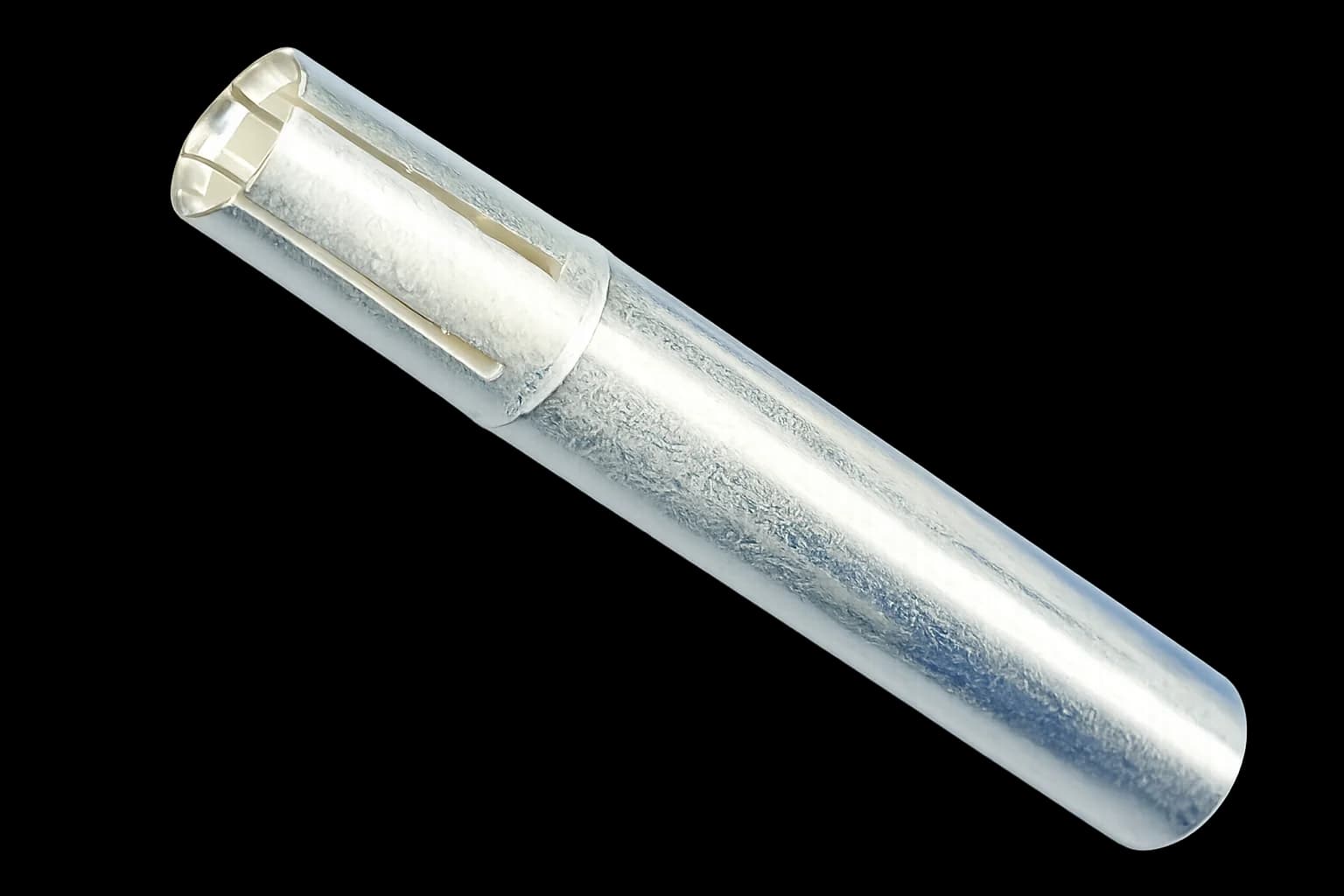
Silver plating of charging-socket contacts is a galvanic treatment carried out by barrel plating, with an electrolytic silver deposit over a copper underlayer. Applied to the contacts of charging connectors, it keeps contact resistance low and stable during continuous charging, even after numerous mating cycles.
Why silver plating
Those are the two things that really matter in a charging-socket contact. Silver plating delivers both.
Resistivity of metals at 20 °C
nΩ·m
Shorter is better. Silver has the lowest resistivity among metals commonly used for electrical contacts.
Among contact-grade metals, silver has the lowest resistivity. Translated: fewer mΩ in series on the charging path.
Silver plating sustains thousands of mating cycles while keeping contact resistance stable. That's why it's specified for charging connectors.
Low contact resistance means less power dissipated under continuous load, even at high currents. The connector runs cooler.
Cross-section · layer stack
How we do it
Under the silver there's always a copper layer: it acts as an adhesion promoter and absorbs thermal and mechanical cycling better. Silver goes on top, the functional layer that meets the male pin.
All on barrel plating, batch by batch. Parts come in bare, leave copper-plated and silver-plated, ready for assembly.
Applications
Almost every sleeve we silver-plate ends up in one place: charging connectors for electric vehicles. It's the contact point between the station and the car, and it has to stay stable under continuous load and after thousands of mating cycles.
Streets, car parks, supermarkets.
Private garages and carports.
Charging hubs for commercial vehicles and car sharing.
High-power networks for short stops. High currents and rapid, repeated cycles.

Frequently asked
We work with copper alloys (such as brass and electrolytic copper), the standard substrate for electrical contacts and charging-socket sleeves. The copper underlayer runs on the same lines, so no dedicated pre-treatment is required.
Both. Barrel plating is efficient on large lots, but there's no hard minimum: we run sample trials, prototypes and continuous production with the same traceability.
It depends on the current workload, but on continuous programmes the delivery cadence can be as frequent as weekly. We agree on fixed pickup windows on a case-by-case basis.